
The World’s Most Powerful Spring Calculator
Design Your Spring in Seconds
Enter your dimensions and get engineering-grade specs, stress factors, and instant pricing across 70 trillion possible spring designs.
Understanding Spring Deflection in Compression, Extension, and Torsion Springs
Definition: Spring deflection, also referred to as spring travel, occurs when a compression spring compresses (under pressure), an extension spring extends (under tension), or a torsion spring twists (radially) upon the application or release of a load.
For deflection to occur in compression, extension, or torsion springs, a load must be applied or released. The distance between the length or position under load and the free or pre-loaded position is recognized as the distance of travel. The traveled distance defines what deflection is, whether through compression, tension, or torsion. Spring deflection is intricately linked to your spring’s rate.
Example 1: The spring rate denotes the force required for your spring to deflect a specific distance during travel. To determine the deflection under a particular load, divide the required load by the spring rate. For extension springs, subtract the initial tension from the load first. In instances where only the spring's required loaded state is known, deduct the loaded position or length from the free position.
Calculate Deflection Using Spring Rate:
Deflection = Load ÷ Rate
D = L ÷ k
Deflection = (Load – Initial Tension) ÷ Rate
D = (L – IT) ÷ k
Calculate Deflection Using Loaded Position:
Deflection = Loaded Position – Free Position
D = LP – FP
Example diagrams:
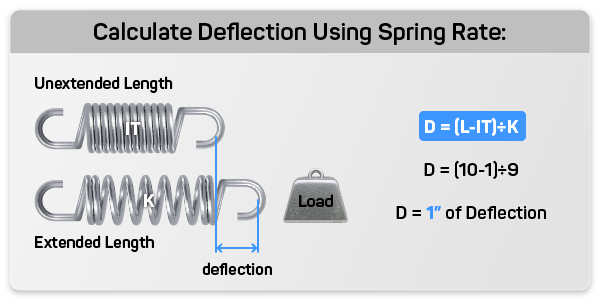
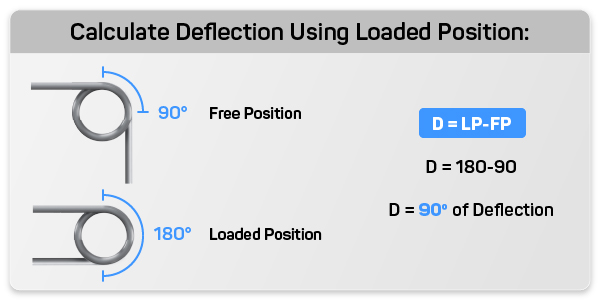
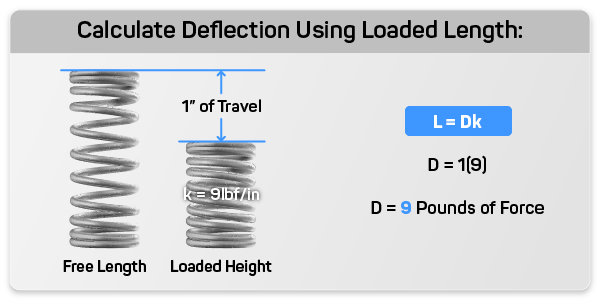
Example 2: The diagrams to the right illustrate how the provided formulas function. Explore further technical articles in our "Tech Info" section. Numerous articles discuss compression, extension, and torsion spring design. The Spring Creator X tool automatically computes spring rate, maximum safe travel, and maximum safe load. As per the rate formula and example below, maximum safe load and travel are each derived from the other.
Calculate Deflection and Load from Each Other:
Deflection = Load ÷ Rate
D = L ÷ k
Load = Deflection * Rate
L = D * k
Calculate Deflection Using Loaded Length
Calculate Deflection Using Loaded Length
Introducing Spring Creator X
The next evolution in spring design. Generate springs in real time, fine-tune critical dimensions, and explore a completely redesigned engineering experience.
Created by Alfonso Jaramillo Jr - President Acxess Spring
Over 40 Years of Experience in Spring Engineering and Manufacturing