
The World’s Most Powerful Spring Calculator
Design Your Spring in Seconds
Enter your dimensions and get engineering-grade specs, stress factors, and instant pricing across 70 trillion possible spring designs.
Spring Design Assistance
Spring Design Assistance
At Acxess Spring, we offer a wealth of technical insights via various articles on spring design throughout our website. Our renowned Spring Creator tool enables users to craft precise compression, extension, or torsion spring designs, complete with a thorough spring analysis and a live blueprint. The design process for springs involves multiple factors, often unfamiliar to many. The comprehensive information provided here, along with the suggested links, serves as a guide to create perfectly functioning springs for your device.
For guidance on using our Free Online Spring Calculator, navigate through our pages:
Compression Spring Calculator Instructions
Extension Spring Calculator Instructions
Torsion Spring Calculator Instructions
Guidance for Compression Spring Design
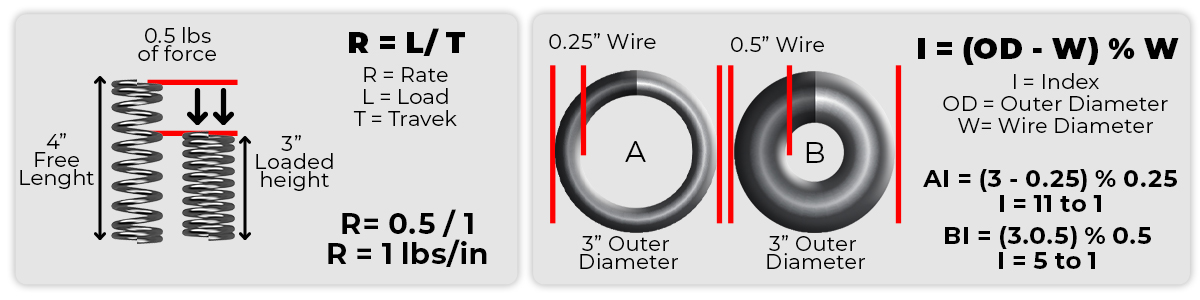
Compression springs are the most commonly used springs due to their popularity and cost-effectiveness. Although relatively easier to design, it is crucial to consider essential factors for their effective functionality. Understanding the compression required and the load to be placed on the spring is key. Calculating the spring rate involves dividing the applied force by the distance traveled, as illustrated in the formula below. However, achieving the desired travel may be impacted by the spring's fatigue limit, considering the spring index. If the index is too small or the solid height exceeds the intended loaded height, the desired travel or load might not be achieved. The coil diameter tightness (spring index) plays a pivotal role. The provided image displays the formula and an explanation for the index.
Spring Rate and Spring Index Diagram
Extension Spring Design Guidance:
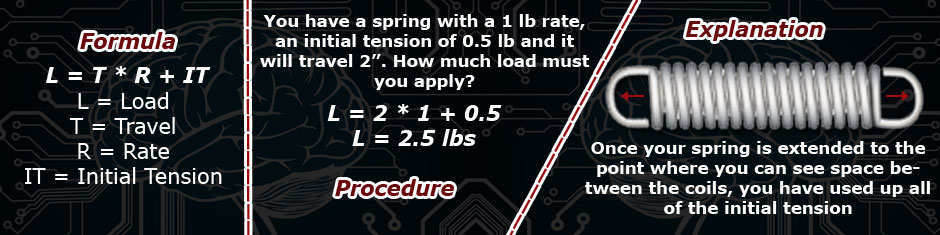
Extension springs, while common, aren't as economical as compression springs due to their typically included hooks. Similar to compression spring design, specific dimensions and the desired extended length under a defined load are essential for extension springs. The rate calculation for extension springs follows a similar formula. However, these springs possess initial tension, which is added to the calculated rate during extension. The initial tension remains constant, not increasing linearly like the rate. The limitations regarding maximum safe travel and load considering hook stress are crucial. Neglecting these parameters can lead to potential breakage of the spring hooks. For extension springs, maintaining a spring index of at least 4 to 1 ensures unhindered travel over the required distance.
Initial Tension Diagram
Exploration of Torsion Spring Technology
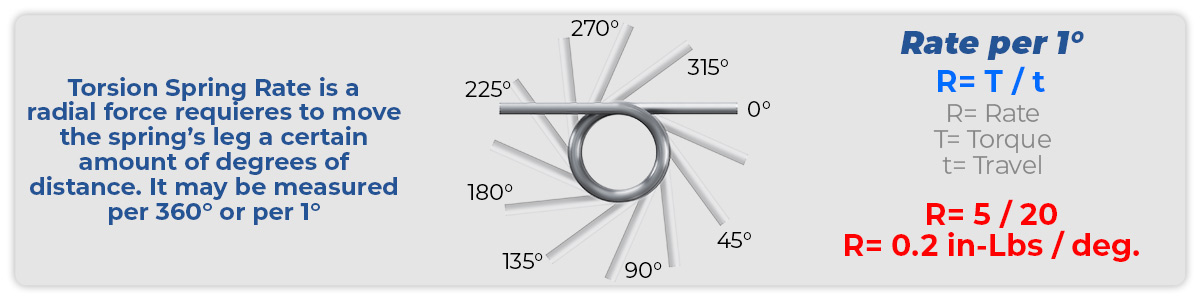
Torsion springs, potentially more cost-effective than extension springs, involve a different approach due to the radial force they employ. Instead of linear measurements, torsion springs deal with degrees of deflection and their rate is measured in inch-pounds per degree. Pay attention to the "maximum load possible" and "maximum safe travel" to ensure the spring functions as intended. As the spring deflects, the inner diameter contracts. This measurement should never be smaller than the diameter of your shaft or mandrel. The unique construction of torsion springs requires precise consideration for their optimal functioning.
Torsion Spring Rate Diagram
Introducing Spring Creator X
The next evolution in spring design. Generate springs in real time, fine-tune critical dimensions, and explore a completely redesigned engineering experience.
Created by Alfonso Jaramillo Jr - President Acxess Spring
Over 40 Years of Experience in Spring Engineering and Manufacturing